
Thirty Three Jones | Desktop Site
A couple of days ago, I read an amazing story in The New Yorker about a French con artist named Frédéric Bourdin, a.k.a. The Chameleon. As a teenager, he would spend months at a time impersonating children who had been reported missing, fooling the authorities, the media and even the families of the missing children despite the fact that he was often ten years older than the child that he was claiming to be. Each time it ended the same way, with Bourdin narrowly escaping punishment after his true identity was inevitably exposed. Eventually he got caught while impersonating a boy from Texas who had been missing for several years, and while facing the prospect of a lengthy stay in prison if he did not "prove" his assumed identity, he managed to convince the boy's family that he was their long lost son.
After making it through a series of interrogations by both Interpol and the FBI, Bourdin moved to America and took up residence with the missing boy's family, becoming something of a local celebrity as a result. For a couple of months, he thought that he had fooled the family into believing that he was their son, despite the fact that his eye color, hair and general appearance were very different. When a news reporter began investigating his story, everything began to fall apart. It became obvious to Bourdin that his new family was well aware of the fact that he was not the missing child, yet they continued to defend him as the reporter, and then the police, built a criminal case against him. It was eventually revealed that the members of the family had killed their son, and that they had gone along with Bourdin's story to cover up what they themselves had done. Bourdin found himself, as things snowballed into something he could not escape, in a situation that was far worse than what he could have ever imagined when he began telling his lies.
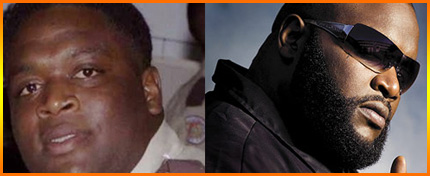
"Interesting story, but what's that got to do with hip hop?," I can hear you asking. Though I didn't comment on it when it first lit up the blogosphere, I've been fascinated by the ongoing saga of "Rick Ross the Correctional Officer." There were a lot of parallels to be found between the story of the French con artist and the life of Rick Ross. Like Rick Ross, Bourdin built up an unbelievable story that managed to deceive a whole lot of people who should have known better. And when the truth was revealed, they both found themselves telling even more lies that could no longer be believed, while everyone else claimed to be shocked by what would have been revealed with even a minimum amount of forethought.
During the peak of Rick Ross' popularity, when Everyday He Was Huss-a-lin' further up the Billboard charts, he admitted in an interview that he had never met Manuel Noriega. This wouldn't have been a particularly significant admission if not for the fact that he had so emphatically claimed to be an acquaintance of Noriega on his single Hustlin':
"I know ... Noriega, the real Noriega, he owe me a hundred favors."
At the time, I wrote that this admission from Ross called into question his entire backstory of being some sort of drug kingpin turned ringtone rapper, a Scarface for the new millennium. The idea that someone as high up in the drug game as Ross claimed to be would give that life up for a shot at making the TRL countdown seemed so absurd to me that I just assumed everyone saw through his facade, or at the very least that his fans had just accepted that he had made liberal use of creative license when crafting the tales of his criminal past. While I took what I felt was an appropriately absurd approach to the story - comparing Rick Ross the rapper to Rick Ross the infamous cult hunter - the reaction to the piece surprised me. It was as if, by calling into question the mythology of Rick Ross, I had also called into question the very validity of those who listened to his music. The reaction was emotional, with at least one longtime commenter leaving this site for good.
(As an aside, after the revelation that Rick Ross worked as a correctional officer at the South Florida Reception Center in Dade County, a processing facility for new inmates, I've begun to suspect that there may in fact be some truth to the line that Ross did indeed know "the real Noriega." Manuel Noriega was convicted, in 1992, for drug trafficking and money laundering, and has been held at the Federal Correctional Institution in Miami (Dade County) Florida for the past 15 years. Ross worked as a correctional officer in Dade County during the mid-90's, so it is entirely possible that he came into contact with Noriega at some point in time. One can only guess what he did for Noriega that would cause the former dictator to owe him "a hundred favors" - extra packs of cigarettes, more time in the yard, extended conjugal visits? The only thing I'm confident in is the fact that it did not have anything to do with Noriega's ties to the drug world.)
In the grand scheme of things, a few rappers lying about their pasts in an attempt to make their onstage personas seem more believable probably doesn't warrant the amount of coverage that has resulted from the unmasking of Rick Ross, and Akon before him. Surely the recently exposed lies from our top politicians deserves more attention; from the FBI's coverup on the origins of the Anthrax scare, to Bush's fabrication of documents used to justify the Iraq war, to virtually the entire executive and legislative branch of our government lying about FISA, there's been a whole lot of news for people to be outraged about in recent weeks. With today's mainstream media, where yellow journalism seems to be the only form of journalism that gets printed, it's hard to shake the feeling that stories like these, or the hundreds of other celebrity items that get round-the-clock coverage from every possible angle, are being used to distract the masses from the issues that really matter. That's nothing new, of course, as it's been going on since the days of the Bread and Circuses in Ancient Rome.
The idea that the media (or the powers-that-be behind the media) might be using stories like these as a smokescreen for the real problems in our country should not come as any sort of revelation, then. My real concern is the farther reaching implications for hip hop, and its fans, when passing oneself off as a hardened criminal - in Akon's case, as a criminal that wasn't even smart enough to avoid being arrested on multiple occasions - has somehow become a positive career move for an emcee. It's a common copout from gangsta rappers to say that they're just responding to what the fans want, that their audience would rather hear tales of drug financed excess than socially conscious lyrics. It may be the case that the fans have influenced what emcees rap about, but it's a two-way street because there are a whole lot of fans listening, and many of them have bought into the fantasy that dealing drugs and walking around strapped is the way to achieve the good life. And this isn't a case of, "Won't someone think of the children?," because there are a whole lot of adults that have bought into the lies as well.
And what's the end result of this glorification of crime and violence? There's a cyclical nature to it, as it leads to real crime and violence as more people buy into it. Which in turn leads to more tales of crime and violence in the lyrics, and on it goes. And this is exactly what they want - "they" being the government, the corporations, the prison-industrial complex and every other entity that's benefiting from the increased disparity of wealth in this country and the increasing conviction rate among our population - as they'd rather you spend your time killing each other and dealing drugs to each other than focusing on improving the condition you find yourself in. Plus it's a lot easier to control a population of convicted felons who have been processed through the system, as they can't vote and they generally have a lot less money to organize any real presence in the government. Hip hop used to be rebellious, anti-establishment music, but these days it seems to be doing more to keep its fans down than to bring them up.
Even if you don't buy into the argument that the lies of Rick Ross, and any other rapper who has yet to get their cards pulled by the Smoking Gun, have far reaching social implications, there's grounds to be upset about the situation from a purely musical standpoint. These fraudulent drug rappers have damaged hip hop in a way that I'm not sure will ever be fixed, by convincing the fans that keeping it real (even if that reality is entirely false) and maintaining that mythical attribute known as "swagger" are more important than any lyrical abilities an emcee might have. How else to explain the success of Rick Ross? Surely he didn't sell a million records off of his ability to rhyme "Atlantic" with "At-lantic". And for that, if for nothing else, he deserves every ounce of humiliation that's been heaped upon him since the Smoking Gun Exposé.
Rick Ross and Akon - Cross the Line
8/6/2007 08:35:01 PM posted by Fresh