Thirty Three Jones | Desktop Site
Seeing as how today, Super Tuesday, is the biggest political event we'll have this year until November 4th, I thought I'd take this post to investigate which one of the Presidential candidates' platforms is most in line with the roots of hip hop. Admittedly, this is a bit contrived on my part, but since so many people seem to be touting Barack Obama as the "hip hop" candidate, I thought it was worth taking some time to examine what's really going on. Please bare with me, as this is going to be a long (and perhaps rambling) post:
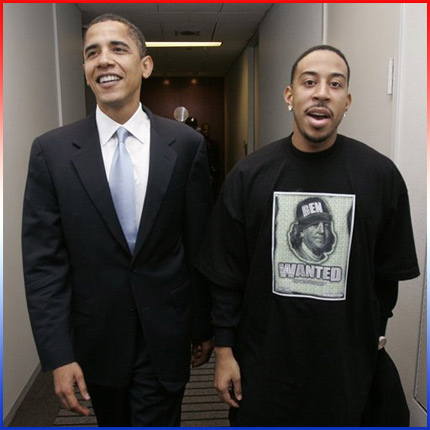
I can't say that I'm at all surprised by Obama's anointment as the Hip Hop candidate. King Magazine seems to have been the first to bestow that label upon him, with numerous other magazines, radio stations and blogs following suit. On the surface, it's an easy argument to make. He's gained the support of various rappers, from Master P to Ludacris to Rhymefest ('Fest even went so far as to call out Lupe Fiasco after Lupe endorsed Hillary Clinton over Obama), and he's said that he will work with rappers to "spread a positive message" if he becomes President. The man even has songs from Jay-Z on his iPod, and played Hov's 99 Problems at the end of one of his fundraisers. Above all else, though, the one thing that seems to have solidified his role as the candidate for hip hop is his skin color. A black man running for the most powerful position in the world...what's more hip hop than that?
What you need to remember, though, is that Barack Obama is a professional politician first and foremost, and while "The First Black President" makes for a great soundbite, it overlooks the reality of our current situation in America, a country that is increasingly being split between the (corporate) haves and the (civilian) have-nots. Sure, it's undeniable that there is still a very significant racial divide in this country. The post-Katrina state of New Orleans has made that abundantly clear, and it would be hard for me to deny that, were Obama to be elected president, it would have a significant impact on the racial dynamics of our political landscape. Yet to latch on to Obama simply because he's black seems, to me, to be incredibly naive.
We aren't living in the Jim Crow era any more, that stark, racially divided era when whites from all economic classes were united in their stance against blacks; the poor (and even the middle class) - whether they're black, white, yellow, brown or any color in between - are increasingly getting the shaft by the Establishment, a government that has now been entirely bought and paid for by corporate interests. Whether you like it or not, as a man who's made a career as a professional politician for the Democratic Party, Obama is most definitely a part of that same Establishment - if he was any sort of threat to the established system of power, you wouldn't see his image plastered all over CNN and Fox News. And though it's easy to forget in this day and age of bland, processed pop rap, hip hop has always been decidedly anti-Establishment, an outsider both in it's musical origins and in the politics of its lyrics. To me, I just cannot accept the idea that a man who is so deeply ingrained in the political process, the political process that hip hop has spoken out against since its inception, could in turn be embraced by that very same community.
If you think Barack Obama is going to do any more for you than any other mainstream politician, simply because he happens to share the same skin tone as you or gives an occasional shoutout to one of the rappers that you listen to, you're a lot more optimistic than I am. To make it to the level where you can even begin to think about campaigning for President, you have to have made an abundant amount of concessions to corporate lobbyists. Obama has made some noise about reforming the process of political fundraising in the past, but the reality of the situation is that once you make it to the Oval Office, all of the fat cats that bankrolled your campaign are going to start calling in the favors that they're owed. And that's when the interests of you, the average citizen, start getting overlooked. If elected, he's going to find himself in the same position as all of the other mainstream candidates, kowtowing to the corporate interests that got him into the Oval Office. To me, that's just not hip hop.
Okay, so assuming you're still with me, you're probably wondering who I would consider to be the Hip Hop candidate. Were he still in the race, I would probably have said John Edwards. Edwards took actual steps, rather than just giving lip service to the idea, to eliminate the influence of corporate lobbyists in his campaign. He also seemed to be the only candidate determined to make an honest effort to eliminate poverty in this country (and that's about as hip hop a platform as you can get, as a large part of the music arose from, and was a response to, the poverty of America). He dropped out of the race, however, so I have to go all the way to the other end of the political spectrum to find the last remaining candidate that embodies the concepts of hip hop: Republican/Libertarian Ron Paul.
If you've spent any amount of time on the internet over the past six months, you no doubt have some familiarity with Ron Paul. He made headlines early in the race for being one of the very few Republicans to speak out against the war in Iraq, going so far as to call for a complete withdrawal of the military, but his legacy as a politician is better defined as a strict Constitutionalist and a proponent for reducing the government. In other words, he is very much anti-Establishment, and not surprisingly, he's been largely ignored by the mainstream media. The only time he does manage to make the news is for all the wrong reasons, as when CNN published a racist newsletter that had some dubious ties to his office (biased coverage from the news media, of course, is something that hip hop is well familiar with).
His political platform essentially boils down to the idea that the government, when left unchecked, will do more to serve its own interests than the interests of its citizens (see: wiretapping and the Patriot Act). Paul, and his Libertarian supporters, would say that the solution is to reduce the government as much as possible. I'll concede that this concept works a lot better in theory than in practice - a reduction in government necessarily brings with it a reduction in funding for various forms of much needed social welfare. Yet the counterpoint is that the government has screwed things up so badly over the past (eight? sixteen? thirty?) years - just look at the complete failure of our government-controlled school systems in inner city areas for one example - that things can't get any worse by reducing government interference, and it comes with the added benefit of restoring our civil liberties. Hip Hop has never been a fan of the government, and has long championed the expression of the individual (as do civil liberties) so this would seem to fall right in line with its core belief system.
Those are the basics, but there are two specific Ron Paul issues that I think the hip hop community can really get behind. First, Paul wants to end the government's so-called "War On Drugs." Or to put it another way, he wants to decriminalize the use and sale of marijuana. Second, he has said that he would drastically reduce the provisions of the DMCA, the law that the RIAA has used to terrorize music listeners of all creeds and colors. And oh yeah, he's also in favor of going back to the Gold Standard, so that dookie chain and all of those gold ropes you've been holding on to since the 80's might actually be worth something.
As if anticipating this very post, Rhymefest shared his thoughts regarding Ron Paul earlier today on his MySpace page. His argument was essentially that he wouldn't even consider voting for Paul because he was running as a Republican. It's unlikely that Rhymefest would support Paul's candidacy even if he knew what it was about, but it completely ignores the fact that Ron Paul is a Republican in name only, a label he's been forced into as part of the two-party system that our country is now governed by (as little coverage as he's gotten from the media, it's far more than he ever would have gotten had he officially run as a Libertarian). And that's one of the biggest problems with our two-party system: it ends up creating a sporting event atmosphere, a "Super Bowl Tuesday" if you will, where the voter is reduced to mindlessly rooting for their team (composed of millionaire athletes/multimillionaire politicians, two groups who live in an entirely different reality from the average fan/voter) to win rather than caring about, let alone making an effort to understand, what the actual candidates represent.
Now having said all of that, I'm not here to tell you to go out and vote for Ron Paul. And I'm not saying you shouldn't vote for Barack Obama, either. From what I know of him (including, somewhat remotely, on a personal level, as he used to work for my father's law firm way back in the day) he seems to be a genuinely decent man. I can't imagine that any candidate, now that Giuliani has been eliminated (and with the possibly exception of Hillary Clinton), could even begin to approach the level of deceit and corruption that our current administration has gleefully fostered over the past eight years, so I'm relatively comfortable in assuming that any change in leadership will be a step towards the positive. All I'm asking is that you take a minute to form your own opinions on the candidates, rather than blindly following the advice of your favorite rapper. Or blogger.
Rant complete, I'll leave you with a brief bit of dialog from So Long, and Thanks for All the Fish, a sequel to Douglas Adams' The Hitchiker's Guide To The Galaxy (recently adapted to film, starring Mos Def) that sums up my thoughts on the electoral process fairly accurately (text jacked from here):
[An extraterrestrial robot and spaceship has just landed on earth. The robot steps out of the spaceship...]
"I come in peace," it said, adding after a long moment of further grinding, "take me to your Lizard."
Ford Prefect, of course, had an explanation for this, as he sat with Arthur and watched the nonstop frenetic news reports on television, none of which had anything to say other than to record that the thing had done this amount of damage which was valued at that amount of billions of pounds and had killed this totally other number of people, and then say it again, because the robot was doing nothing more than standing there, swaying very slightly, and emitting short incomprehensible error messages.
"It comes from a very ancient democracy, you see..."
"You mean, it comes from a world of lizards?"
"No," said Ford, who by this time was a little more rational and coherent than he had been, having finally had the coffee forced down him, "nothing so simple. On its world, the people are people. The leaders are lizards. The people hate the lizards and the lizards rule the people."
"Odd," said Arthur, "I thought you said it was a democracy."
"I did," said ford. "It is."
"So," said Arthur, hoping he wasn't sounding ridiculously obtuse, "why don't the people get rid of the lizards?"
"It honestly doesn't occur to them," said Ford. "They've all got the vote, so they all pretty much assume that the government they've voted in more or less approximates to the government they want."
"You mean they actually vote for the lizards?"
"Oh yes," said Ford with a shrug, "of course."
"But," said Arthur, going for the big one again, "why?"
"Because if they didn't vote for a lizard," said Ford, "the wrong lizard might get in."
"What?"
"Some people say that the lizards are the best thing that ever happened to them," he said. "They're completely wrong of course, completely and utterly wrong, but someone's got to say it."
2/05/2007 09:00:01 PM posted by Fresh