Thirty Three Jones | Desktop Site
A couple of months ago, I lamented the fact that few, if any, mainstream hip hop artists showed any awareness of political events. Judging from the influx of chain letter emails I have received from various rappers and DJs over the past two weeks, its becoming clear that there is a political cause that much of the hip hop community is beginning to speak out about: the conflict between Israel and Hezbollah.
When I first started writing this blog, I signed up for just about every email list I could find for hip hop artists, hoping that I would receive a bunch of free music or at least have something to write about here. For the past year, the only thing I got from these emails were a bunch of concert and club appearance dates and the occasional 32kbps mp3 sampler. Around the start of this month, though, I began receiving a bunch of political emails from the artists on these email lists, all of them with a decidedly anti-Israel viewpoint. The emails contained brutally graphic photos of dead Lebanese women and children followed up with strong words condemning the government of Israel. Normally, I would be ecstatic that the hip hop community had begun to shown signs of political awareness, yet these emails that I received displayed a complete ignorance of what was going on in the Middle East. I'm not saying I disagree with the overall opinion that these emails were supporting, that the death of Lebanese civilians is a very real tragedy, but it concerned me that these artists were blindly going along with the "facts" presented in these chain letters. It also occurred to me that, if the artists had no real awareness of what was going on in Israel and Lebanon, then there's a good chance the majority of fans don't know what's going on either. I decided to take a quick break from the usual music talk on this site and give you guys a brief history lesson, which coincidentally gives me a chance to use my four years of college education that I devoted to the study of Middle Eastern and Eastern European International Relations (a college degree that, you may be surprised to hear, has not been particularly useful in my professional career as a web developer). This is by no means a definitive account of events, just something put together to encourage the rest of you to go do a bit of reading on the subject and form an opinion of your own. For the record, I've now received emails from 13 different artists decrying the acts of Israel. The latest email, and the one that motivated me to write this, was from Shae, a member of N.E.R.D.
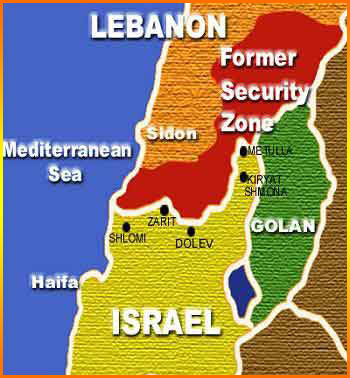
While the conflict between Lebanon and Israel can be traced all the way back to the 1948 Arab Israeli War, it is more a direct result of the 1982 Lebanon War, when Israel invaded southern Lebanon in response to an attempted assassination of one of their ambassadors by a group of Palestinians (southern Lebanon at the time had a large Palestinian population). Israel defeated the majority of the PLO forces in the area and maintained a military presence in Southern Lebanon at the end of the war. In 2000, Israel finally completed its withdrawal from Southern Lebanon but continued to control an area known as the Shebaa Farms, which the Lebanese claim is part of their own territory.
In response to the Israeli occupation of Southern Lebanon, Hezbollah was founded in 1985 with the help of Iran and Syria. The group has both a political and a military wing, with the political wing controlling a small portion of the Lebanese Parliament. The stated goals of the group are to force Israel to withdraw from Lebanon and for the Israeli government to release all Lebanese prisoners that it held. The manifesto of the group also declares that the state of Israel is illegitimate. To achieve their goals, Hezbollah has been involved in numerous terrorist attacks, including one of the first ever suicide bombings in 1983, when a U.S. military base was destroyed. More recently, however, Hezbollah has condemned terrorist attacks by other groups, at least publicly. While the majority of Lebanese civilians do not support the actions of Hezbollah, the group does have a strong following in the Southern part of the country.
Conflict between Hezbollah and Israel started back up on July 12th of this year, when Hezbollah crossed the border into Israel, capturing two Israeli soldiers and killing three others. The goal of the Hezbollah attack was to capture Israeli soldiers that could later be exchanged for Lebanese prisoners. Israel's response was to declare Hezbollah's actions an "act of war" and began bombing Lebanon. While Israel held Lebanon responsible for the attacks, the Lebanese Prime Minister claimed that he had no knowledge of the Hezbollah plan. The Lebanese government has little to no control over Hezbollah, so this is a fairly believable claim.
The biggest tragedy in this conflict has been the loss of innocent life in both countries. The attacks from both Israel and Hezbollah have killed Lebanese, Israeli and Palestinian civilians. Amnesty International has condemned both sides in response to these deaths, and both sides could potentially be charged with war crimes when the conflict ends. There has been some disagreement over Israel's responsibility for Lebanese civilian casualties, though, as Hezbollah has been accused by the U.N. of intentionally blending in with women and children to maximize civilian deaths. There has been little debate over the fact that Hezbollah has intentionally targeted civilian areas with their rocket attacks, however. On the other hand, Israel has been roundly criticized for the disproportionate military response, with reports of up to 1000 Lebanese civilians killed -- a number that seems severely unbalanced when weighed against the capture of 2 Israeli soldiers (and 3 deaths).
On August 4th, the United States and France drew up conditions for a ceasefire that would require all military organizations within Lebanon, other than the official Lebanese military, to disarm and for an international peacekeeping force to be stationed on Lebanon's border with Israel. Lebanon has rejected this proposal, due to the fact that the conditions do not require an immediate withdrawal by the Israeli military. Israel is not willing to withdraw from Southern Lebanon until the U.N. arrives, fearing that if it leaves Hezbollah in the area, the group will continue to launch attacks across the border.
Ultimately, the debate over this conflict hinges on two issues: whether or not Israel has a right to self defense (and whether or not its attacks on Beirut fall under the category of "self defense"), and whether or not Israel's military response can be labeled as "disproportionate."
My personal opinion? I don't think Hezbollah will ever peacefully accept a border with Israel, and I think that Israel is well within its rights to take military action to remove the threat of Hezbollah in the name of self-defense. At the same time, I think they've gone too far in their attacks on Beirut and the resulting civilian casualties are troubling to say the least. The Lebanese government has a fairly weak military and they should not bare full responsibility for the actions of Hezbollah, since they do not have the capability to control that group.
A friend of mine currently plays basketball for an Israeli pro team and lives in Tel Aviv, so I do have some personal interest in the situation. Between that and the fact that my life has been severely affected by issues that originated in the Middle East, I concede that I have a bias when discussing conflicts in that region.
Anyway, that's it for today's history lesson. I hope at least a few of you made it through to the end. If you're interested, here are a few more links for further reading on the topic (the first two links do a good job of covering both sides of the issue):
Debate over Reuters' potentially biased reporting on the conflict.
Discussion of Hezbollah's tactics of using civilian populations.
DallasPenn's take on the conflict
BloggingBeirut, a blogger living in Beirut
On a lighter note, Gramz (member of the bsp massive) did some serious digging in the crates to put together Volume 3 of his Bake McBride Soul Sessions mix series. Go download it here. Its a must listen for any hip hop fan, with the hour long mix covering the original sources for the samples of a whole lot of your favorite hip hop songs, from Redman's Superman Lover to Public Enemy's Your Gonna Get Yours to Wreckx-N-Effects Rump Shaker.
8/11/2006 10:17:34 AM posted by Fresh