Thirty Three Jones | Desktop Site
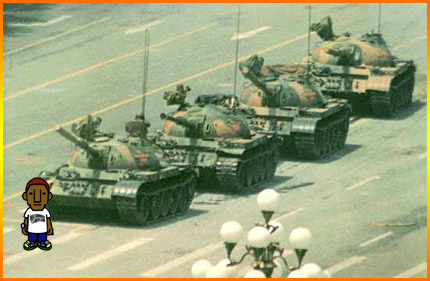
MTV has a new article on their site, Where Is The Voice Of Protest In Today's Music? Its a fair enough question to ask. According to the Washington Post, in an article released yesterday, the President's approval rating was at the lowest percentage ever in the history of the Post's polling. Love him or hate him, there have certainly been enough controversial actions taken by our government that, in previous generations, would have resulted in an abundance of protest songs.
I'm not going to debate the politics of our current administration, as there are certainly enough blogs out there that cover both the pros and the cons of the government. What I'm interested in today is the question of why hip hop, the genre of music that had taken over from rock 'n roll as the voice of rebellion through the 80's and 90's in our society, no longer has the ability to make coherent political statements that are able to reach a broad audience.
Looking back, the late 80's and early 90's are cleary the point at which hip hop reached its peak of political relevancy. At the forefront of political rap was Public Enemy, who achieved commercial success among black and white audiences despite their militant appearance and eqaully militant lyrics. P.E. occasionally made poor judgements in the causes they took up, namely the Tawana Brawley case and Professor Griff's anti-semitic conspiracy theories, but more often than not the political statements they made received about as much respect as any music act could hope for.
Public Enemy was not the only group out there making noise on the political front, though. Even a group like N.W.A., known primarily as one of the originators of gangsta rap, were more politically aware than most rappers today (at least up to Straight Outta Compton). Through their descriptions of life in Compton, they exposed America to some harsh realities, detailing the prevelance of drugs and police corruption in their neighborhood. These days, if you hear a song entitled Dopeman its more likely to be about a rapper's alleged success on the street corner rather than an expose on the dangers of drug use. And when Jay-Z was saying Fuck the Police on 99 Problems, he was bragging about getting away with a trunk full of drugs rather than expressing any outrage over being pulled over for a DWB.
These days there are some rap groups out there making political statements, but these groups fall within one of two categories that keep them from being relevant to mainstream audiences. Most prolific are the underground rap acts, like The Coup and The Dead Prez, groups that are committed to political activism. By their very nature, though, the "critical acclaim to actual sales" ratio for these groups is way too high to gain them any real relevance. Making things even harder is the fact that music labels are not about to put any marketing behind a group with a controversial message, and somehow lyrics with a political message have become significantly more controversial than rapping about selling drugs. Sure, you might have a whole lot to say about how the problems of the world can be fixed, but if nobody's buying your records then nobody's listening to your message.
The other category of today's political rap comes from what can be labeled the "Hypocritical Rapper." These are rappers who have spent the majority of their careers promoting violence and/or materialism and suddenly decide to make a political statement in direct contradiction to everything they've had to say up to that point. Perhaps the most famous example of this in recent years was Kanye's "George Bush Does Not Care About Black People" outburst. Kanye followed this up with his single about Conflict Diamonds. No doubt the atrocities being committed in Western Africa are worthy of discussion, but its hard to hear what Kanye has to say about it when his words are drowned out by the sound of "bling bling" coming from the diamond studded Roc-A-Fella chain around his neck.
Another recent example would be Juvenile and his "tribute" to the victims of Katrina, Get Your Hustle On. Juvenile, as a resident of New Orleans, had every right to be outraged by the mistakes made by the government in the aftermath of the hurricane. But in a city that had 10 times the national average of crime rate, is it anything but laughable to hear that his solution to the city's problems is for people to go buy cocaine with their FEMA checks? Just because you put some kids in your video with masks of Cheney, Bush and Nagin doesn't make the song political and doesn't cover up the ignorance in your message. People watch Juvenile videos to see girls Back That Azz Up not to see what he has to say about Ray Nagin.
With the situation in hip hop, I don't think we'll be seeing any currently established rap artists find success if they suddenly start to express any form of political activism. There are almost no mainstream rappers out there who haven't devoted at least some portion of their careers to dropping lines about extravagant materialism or their (often imaginary) lives as drug dealers. Its too hard for the listener to maintain their suspension of disbelief when someone like that attempts to raise their consciousness. Take the Diddy-sponsored Vote Or Die campaign from the 2004 election. That ended up as a merely a fashion statement, with a bunch of celebrities wearing tshirts with the slogan, but never actually going out and voting.
In my opinion, the only hope is for some as-yet-unreleased artist with a fresh slate to come along with the right combination of style, beats and lyrics to be able to achieve success as a politically aware rapper. The only rapper I can possibly see doing this is Saigon. My hopes are not high.
Today's track is a mashup of the Dead Prez' Hip Hop, using the beat from Black Rob's Whoa. Try to fully appreciate the DP's message while their lyrics are laid over a Bad Boy beat. Its hard, right? That's what its like, to me at least, when I hear Kanye rap about something political.
(track after the jump -->)
5/18/2006 10:25:50 AM posted by Fresh