Thirty Three Jones | Desktop Site
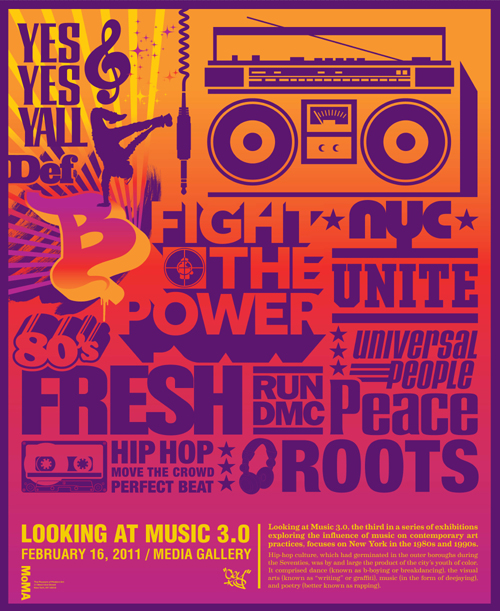
This past week Rafi from ohword put up a link to an article by Bill Adler, one of the founding members of Def Jam, discussing a new exhibit at the Museum of Modern Art (MoMA) dealing with the origins of Hip Hop. The exhibit, the third installment of MoMA's Looking at Music series, covered American music from the 80's and 90's. Put together by MoMA's Video and Media curator Barbara London, the exhibit focused on the early years of hip hop with many of the items on display on loan from Adler. He appropriately referred to it as the "Hip Hop 1.0" exhibit.
I went into the city this past Saturday to see the exhibit, and I was left with decidedly mixed emotions about it: satisfaction that hip hop was being acknowledged as a legitimate artform by an institution like MoMA, but dismay at the narrow, and somewhat skewed, view of the music that it offered up. Before going any further, I should say up front that I am not a huge fan of modern art, so I may not have been as receptive to it as others, and the possibility exists that the concept behind the exhibit went over my head. It's located on the second floor of the museum, a floor that houses the cutting edge of its modern pieces - disassembled computers encased in glass, a stack of hay with a golden needle in it, portrait photography of everyday people. The kind of art that professional critics go nuts over, but leaves the average person wondering what all the fuss is about.
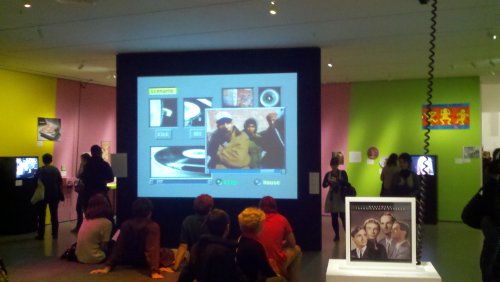
A Tribe Called Quest's Scenario video playing on the exhibit's main screen. The video continuously looped through Scenario, a song from Eric B and Rakim (I don' remember the exact one, but I believe it was My Melody) and a Kraftwerk song.
The room for the exhibit is dominated by a large projection screen, with a sitting area in front of it, that plays a continuous loop of three videos: A Tribe Called Quest's Scenario, a video by Eric B and Rakim (I didn't take notes, so some specifics such as the particular Rakim video escape me), and a Kraftwerk video. Around the room are smaller television screens playing videos that highlight various genres and contributors, one highlighting New Jack Swing, another highlighting the work of Spike Jonz. On the walls there are a handful of black and white inkjet photographs of artists from the 80's: Afrika Bambaata, Grandmaster Flash, the Treacherous Three, Fab Five Freddy, Salt N Pepa.
Alongside the photos are a few posters, including one of the original promos for NYC's Fresh Fest '84 and Public Enemy's album It Takes a Nation of Millions to Hold Us Back. In addition, a few original 12" vinyl covers are posted up on the wall, with the highlight being Eric B and Rakim's Paid In Full. There are also a few cds highlighted, connected to headphones allowing people to listen to the albums: the Beastie Boys' Paul's Boutique, Wu Tang's Enter the 36 Chambers, Bambaata's Planet Rock, and Run DMC's Raising Hell. Rounding it out are a couple of original works, mostly built around vinyl records. Next to each photo, poster, etc., is a small writeup explaining its significance. I don't know if it was the intent of the exhibit, or just a result of what pieces were provided by Adler, but the focus is entirely on New York artists. (There is a small section covering other music from the 80's and 90's - Madonna, Weezer - but this is almost entirely a collection of hip hop.)
As someone who grew up with hip hop and experienced it firsthand, going to the exhibit was a somewhat unsettling experience. The majority of the visitors were older, wealthy Manhattanites mixed in with the occasional teacher-led group of grade school students. The type of people who, at best, had only a passing familiarity with the material that was being presented. I imagine what I felt while I was walking through the exhibit was not unlike that of someone who lives near a tourist attraction, watching people take a momentary, disposable interest in what I live every day. More than once I had to resist the urge to lecture people about everything that wasn't covered. That, undoubtedly, is one of the reasons why this exhibit did not resonate with me; I went into it expecting to see things I had never seen before or at least see things presented in a way that I had never considered them, a visual equivalent of The Big Payback perhaps, but instead found myself staring at things that, to any hip hop head, were fairly routine.
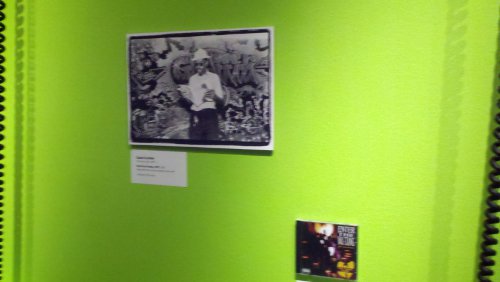
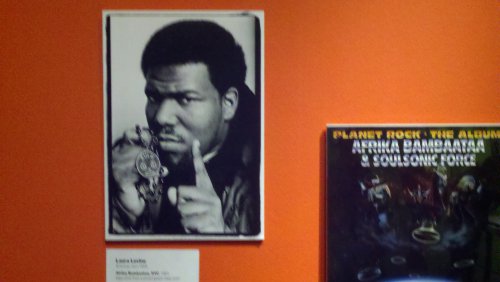
A photo of Fab 5 Freddy, donated by Freddy himself. Below that you can see the cd cover for Wu Tang's Enter the 36 Chambers. Each cd in the exhibit had a pair of headphones attached to it, which you could use to listen to the album.
What disappointed me about the exhibit is that it seemed almost sterile. Hip hop has visual art built right into it - the art of graffiti and the art of b-boying - but the little of that on display was shown in just the briefest glimpses and merely by coincidence. Even the more traditional forms of art, the kind of art that can be found throughout MoMA, have connections to hip hop - Fab Five Freddy came up with Basquiat! - but again, that was never mentioned. Nor was there any consideration of the, perhaps baser, art of branding that helped drive hip hop to mainstream success. Public Enemy and Run DMC were featured, but their iconic logos were nowhere to be found. It was interesting to see the early photographs of some of the originators of hip hop, but they just didn't capture the essence of hip hop. It's hard for me to believe this didn't work out better, because hip hop has had so many great visual moments in its history. If I only had one image to explain to someone what hip hop was, it would be a no brainer: hip hop is Kool Herc cruising around the streets of the Bronx with eight foot speakers hanging out the back of his convertible. But there was nothing as striking as that here.
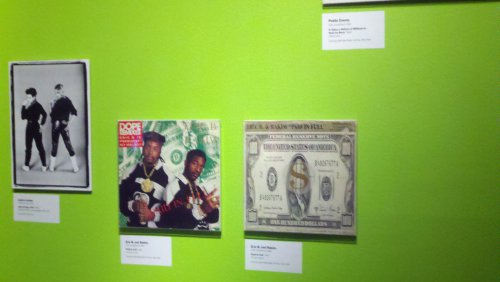
On the right, the original 12" cover for Eric B and Rakim's Paid In Full.
Perhaps more importantly, though, is that the exhibit offers up a distorted view of hip hop's origins. If your only exposure to hip hop was through this exhibit, you'd be left with the impression that Kraftwerk was the singular influence on hip hop's sample-based sound, that Spike Jonz was the most significant videographer of the genre, and that the music was spread exclusively through vinyl and MTV. Pioneering producers like Kurtis Blow and Mantronik, videographers like Spike Lee and Hype Williams, boomboxes and cassettes, went unmentioned. As for the albums that are highlighted, the selected few are undoubtedly classics but it's hard to develop a full view of hip hop (and specifically NY hip hop) while leaving out the likes of BDP, the Juice Crew and Biggie. It is a very downtown Manhattan view of hip hop's origins, but perhaps that's what was needed to get MoMA's interest.
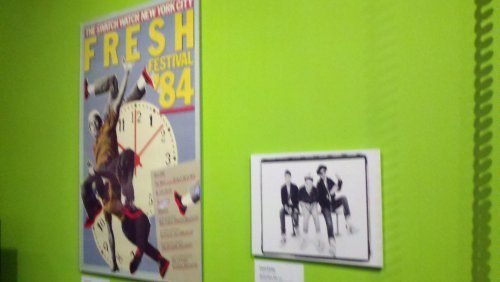
On the left, one of the original promo posters for the legendary '84 Fresh Fest, a concert series that many people consider as one of the events that led to hip hop becoming a national phenomenon rather than just a regional one.
Ultimately, what I think really hurt the exhibit is the very fact that it's being held at MoMA. To quote The Chronic, "hip hop should be played at loud volumes..." but I was struck by just how quiet this exhibit was and I think that's just the nature of the museum itself. The main loop of videos played with sound, but it ended up serving more as background music than anything else. I expect a hip hop exhibit to have everyone, at the very least, nodding their heads along to whatever beat is playing. But here, everyone just politely examined each piece and moved along. If this is what a hip hop retrospective looks like when it's collaborated by someone who was there from the very start, I'd hate to see what a similar exhibit will look like a couple of generations from now. It has me concerned about the long term efforts of preserving hip hop's legacy.
Having said all of that, if you live anywhere near the city I still recommend that you visit the exhibit and form your own opinion. It's rare that hip hop gets respect from an institution like MoMA, and at the very least it will give you an excuse to check out all of the other great art that the museum has to offer.
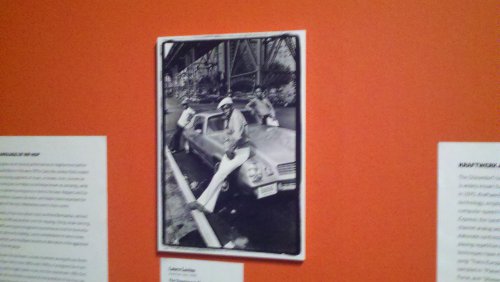
My camera work was a little dodgy on this one, but I believe this is a photo of the Treacherous Three.
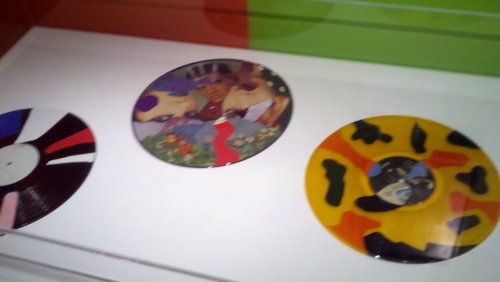
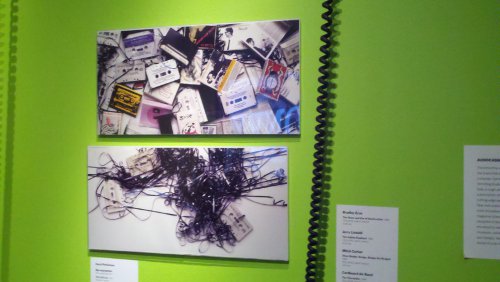
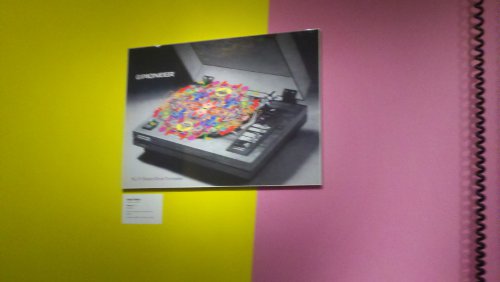
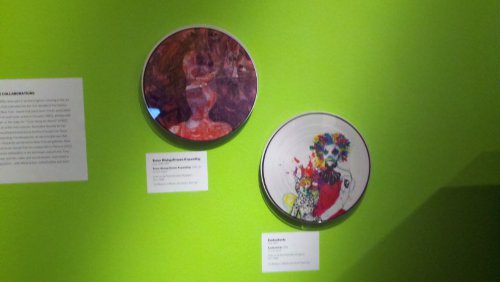
I don't know if it's evident from this photo, but those are commercially released records, not painted on designs.
The next three photos were from exhibits unrelated to the Music 3.0 show:
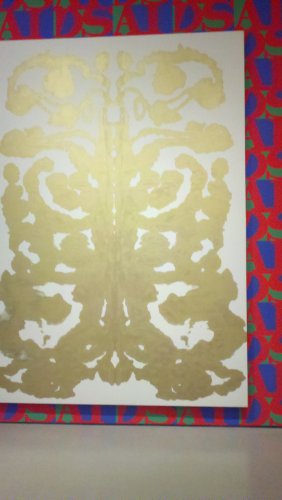
This is the Andy Warhol Rorschach painting that is used on the cover for Jay-Z's recent book Decoded.
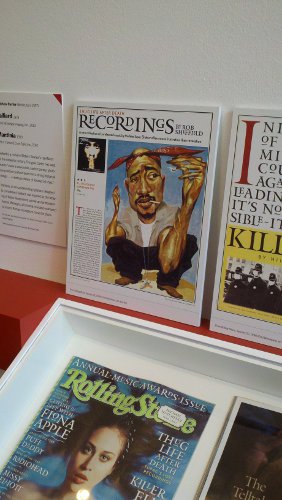
The above image from a Rolling Stones' article on Tupac was part of an exhibit on Fonts. The Tupac article was used as an example of the Galliard font.
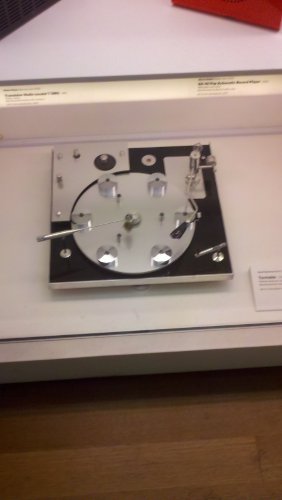
A turntable from the 1950's.
3/27/2011 6:30:00 PM posted by Fresh