
Thirty Three Jones | Desktop Site
Boogie Down Productions - You Must Learn
When I was in grade school, I used to listen to Boogie Down Productions on a constant basis. At such a young age, however, the meaning behind much of KRS-1's lyrics flew right over my head. It was good enough that the beats were dope, so I didn't really bother to catch all of the knowledge that the Blastmaster was kicking in his rhymes. One song that did stand out for me even then, though, was You Must Learn. Whenever one of my parents, or one of my teachers at the time, criticized me for listening to hip hop I could always recite a few of the lines from the song. I didn't necessarily know who Lewis Latimer was - and my fourth grade history lessons certainly didn't enlighten me - but the mere fact that I could namedrop him was enough to get the elder critics off my back for listening to the music.
Some twenty (plus) years later, I once again heard the song while flipping through my iPod and I had to stop and reconsider the various names that KRS shouted out in the second verse:
I believe that if you're teaching history
Filled with straight up facts no mystery
Teach the student what needs to be taught
'Cause Black and White kids both take shorts
When one doesn't know about the other ones' culture
Ignorance swoops down like a vulture
'Cause you don't know that you ain't just a janitor
No one told you about Benjamin Banneker
A brilliant Black man that invented the almanac
Can't you see where KRS is coming at
With Eli Whitney, Haile Selassie
Granville Woods made the walkie-talkie
Lewis Latimer improved on Edison
Charles Drew did a lot for medicine
Garrett Morgan made the traffic lights
Harriet Tubman freed the slaves at night
Madame CJ Walker made a straightenin comb
But you won't know this is you weren't shown
The point I'm gettin' at it it might be harsh
'Cause we're just walkin' around brainwashed
So what I'm sayin' is not to diss a man
we need the '89 school system
One that caters to a Black return because you must learn...
Perhaps I've just grown more cynical in my old age, but I was curious to see just how many of the facts KRS got right so I headed to the greatest library on Earth, google, to find out. What follows is an admittedly rudimentary overview of the various figures that he mentions and, though it won't cover much more than what you can find in Wikipedia, it should at least give you some starting points if you're interested in more information. Of course, if you're not looking for a history lesson just nod along to the above video and keep it moving.
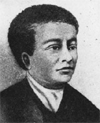 Benjamin Banneker - Born in 1731 in Maryland, Banneker began studying astronomy at the age of 57. He collected his astronomical calculations and observations, along with various essays and a full calendar, in a series of journals that eventually evolved into the first Almanac.
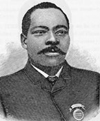 Granville Woods - Known as "The Black Thomas Edison," the prolific inventor Woods' most productive years came during the late 19th century in Columbus, Ohio. He spent the majority of his time devising ways to improve the performance and reliability of electric railways, and invented the Synchronous Multiplex Railway Telegraph, which allowed engineers to communicate between the train station and moving trains. Alexander Graham Bell purchased the rights to Woods' invention, though he was later sued by Thomas Edison. Edison claimed that he invented the multiplex telegraph first, though Granville Woods eventually won the lawsuit and turned down Edison's subsequent offer of employment.
Woods' multiplex telegraph was a major breakthrough in communications, but KRS-1's claim that he invented the Walkie-Talkie isn't quite accurate. Though Woods' invention was certainly the precursor to it, the first modern "Walkie-Talkie", which was so heavy it had to be carried in a large backpack, was developed in 1940 by a team of engineers at Galvin Manufacturing Company, the predecessor of Motorola.
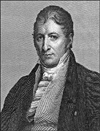 Eli Whitney - Whitney's invention of the cotton gin, a device that removed the seeds from cotton and revolutionized the cotton industry, and the larger concept of manufacturing were two of the most important developments in early U.S. history. The cotton gin led to a dramatic increase in slavery in the South, while manufacturing, and the idea of interchangeable parts that came with it, played a large role in the North's eventual victory in the Civil War. There is some debate, however, as to whether Whitney was the true inventor of the gin or if he, in a time when women were not allowed to hold patents, merely filed the paperwork on behalf of Catherine Littlefield Greene.
This all avoids the larger issue, however, that should become immediately apparent after seeing the above picture of Mr. Whitney: he's white! A brief scan of google seems to point to the fact that many people were taught that Eli Whitney was black - I seem to recall being told that by one of my teachers at some point during grade school - so we'll have to give KRS a pass on this one.
 Haile Selassie - Breaking the theme of the verse, Selassie was not American nor did he invent anything of note that I'm aware of. He was, nonetheless, an important historical figure, leading Ethiopia in its war against Mussolini's Italy during the lead up to World War II (Ethiopia itself is notable for being, prior to Selassie's reign, the only African nation to resist European colonialism through force). As any fan of Bob Marley is no doubt aware, Selassie has since become an icon among Rastafarians and is believed by them to be a Messiah who will one day lead the people of Africa to a sort of heaven on Earth.
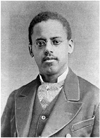 Lewis Latimer - As revolutionary as the invention of the lightbulb was - an invention credited to Thomas Edison and Joseph Swan - it's usefulness was initially limited due to the fact that the bulbs tended to burn out rather quickly. Enter Lewis Latimer, who, after working for Edison himself, "devised a way of encasing the filament within a cardboard envelope which prevented the carbon from breaking and thereby provided a much longer life to the bulb and hence made the bulbs less expensive and more efficient. This enabled electric lighting to be installed within homes and throughout streets." (source) KRS-1 most definitely got this one right when he said, "Lewis Latimer improved on Edison."
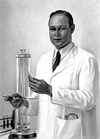 Charles Drew - Drew, a physician whose relatively brief life spanned from 1904 to 1950, certainly "did a lot for medicine," as the Blastmaster said. Serving as the director for the Blood for Britain project, he pioneered the use of several techniques for storing, handling and preserving blood plasma, techniques that were used extensively during World War II to save the lives of thousands of injured Allied soldiers.
Drew's death in an auto accident at the age of forty-five eventually became fodder for an urban myth, in which it was told that he, one of the founding fathers of blood transfusion, was denied that very treatment due to the fact that he was black. The Straight Dope ran an article disproving that story:
' In 1950, while driving three other black doctors to a conference in Alabama, Drew fell asleep at the wheel. The car swerved and rolled over, breaking his neck and crushing his chest. According to legend, he desperately needed a blood transfusion, but doctors at a hospital in Burlington, North Carolina, refused to admit him, and he died.
This story is told in several black history books and has been repeated by Dick Gregory, among others. But it isn't true. Morris spoke with Dr. John Ford, one of the passengers in Drew's car. "We all received the very best of care," Ford said. "The doctors started treating us immediately."
Drew didn't receive a transfusion because his injuries wouldn't permit it. "He had a superior vena caval syndrome--blood was blocked getting back to his heart from his brain and upper extremities," Ford said. "To give him a transfusion would have killed him sooner. Even the most heroic efforts couldn't have saved him. I can truthfully say that no efforts were spared in the treatment of Dr. Drew, and, contrary to popular myth, the fact that he was a Negro did not in any way limit the care that was given to him."'
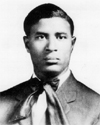 Garrett Morgan - The son of former slaves, Garrett Morgan is often credited as the inventor of traffic lights. By the time Morgan invented his version of the traffic light system, in 1923, there were already several other versions in place (the first traffic signal of any sort appeared in London in 1868). Like the other traffic lights of the time, Morgan's were operated by hand, though his system was something of an improvement in that it allowed the traffic light operator to change the lights from a distance rather than having to stand directly next to the light pole. However, the idea that Morgan was the inventor of the modern traffic light - an idea espoused by many historians, not just KRS-1 - has been called into question (or debunked outright, depending on who you believe) due to the fact that numerous patents for very similar systems existed years before Morgan's patent was filed.
Though Morgan's work with traffic lights has garnered him the most attention, he was at the time more highly regarded for his rescue of several tunnel workers, who were trapped after an explosion at Lake Erie in 1916, using another one of his inventions, the Safety Hood. As with his traffic lights, there has been some debate over the Safety Hood's legacy, though it has been argued that this served, in part, as an inspiration for modern day gas masks.
Morgan, as with many other black inventors of the time, often had to give credit to his white business partners in order to generate any sales and, on the rare occasion that he went out on a sales trip himself, presented himself as a Native American to potential investors and buyers.
(As an aside, I should note that during virtually any discussion of an invention by a black man, someone inevitably comes along to argue that a white inventor came up with the idea first. Many of the debates are undoubtedly motivated by an interest in unearthing the true historical facts, but the racial undertones are hard to overlook and make the search for the true origins of any given invention on the internet an effort in futility.)
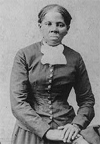 Harriet Tubman - I can only hope that our school systems haven't failed so badly that whoever is reading this isn't at least vaguely familiar with the name Harriet Tubman. A former slave who gained her freedom by escaping to Philadelphia, Tubman eventually returned to her home state of Maryland to help other slaves, including her family, flee to the north under the cover of darkness. Later, she joined the Union Army and became the first woman in U.S. history to lead an armed expedition, the Raid at Combahee Ferry, which freed over seven hundred slaves.
As with many black soldiers, Tubman received very little compensation for her service and it took the government several years to even acknowledge her role in the war.
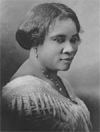 Madame C.J. Walker - Born in 1867, Walker made her name in women's hair care products. After her hair began to fall out as a result of the various products she was using, she began to develop her own hair care line, including the straightening comb that KRS mentions. I'll leave it up to Chris Rock to debate the merits of hair straightening, but it's worth noting that Madame Walker is listed in the Guiness Book of World Records as the first female to ever become a self-made millionaire.
Bonus lesson:
The video for You Must Learn opens up with KRS-1 reciting one of the lines from Why Is That? to a high school class:
" Genesis Chapter 11, Verse 10 explains the genealogy of Shem. Shem was a black man in Africa. If you repeat this fact, they can't laugh at ya."Here are verses 11 and 12 from Genesis, Chapter 11:
"These are the generations of Shem: Shem was a hundred years old, and begat Arphaxad two years after the flood:The Bible, as well as various Islamic texts, make reference to God dividing the Earth among Shem and his two brothers, Ham and Japheth, with the genealogical line of Shem eventually leading down to Jesus. Further, tradition holds that each brother had a different skin color, but unfortunately KRS doesn't get it quite right with Shem. Shem is usually considered to be a descendent of the Adamic line, which is Hebrew for "reddish" or "swarthy," while Ham is referred to as being black and Japheth as white. The larger point, that the image of Jesus in mainstream culture is unlikely to be an accurate representation of reality, is nevertheless worthy of consideration.
And Shem lived after he begat Arphaxad five hundred years, and begat sons and daughters."
If I haven't bored you all with this, perhaps at some point in the near future we'll investigate the history behind the third verse, starring JF Blumenbach and the origins of racism.
11/02/2009 9:00:51 PM posted by Fresh