The Ninja in the Room: One White Critic's Solution and Everyone Else's Problem
There's a specific moment in mid-2006 where you can locate the exact spot this all started.
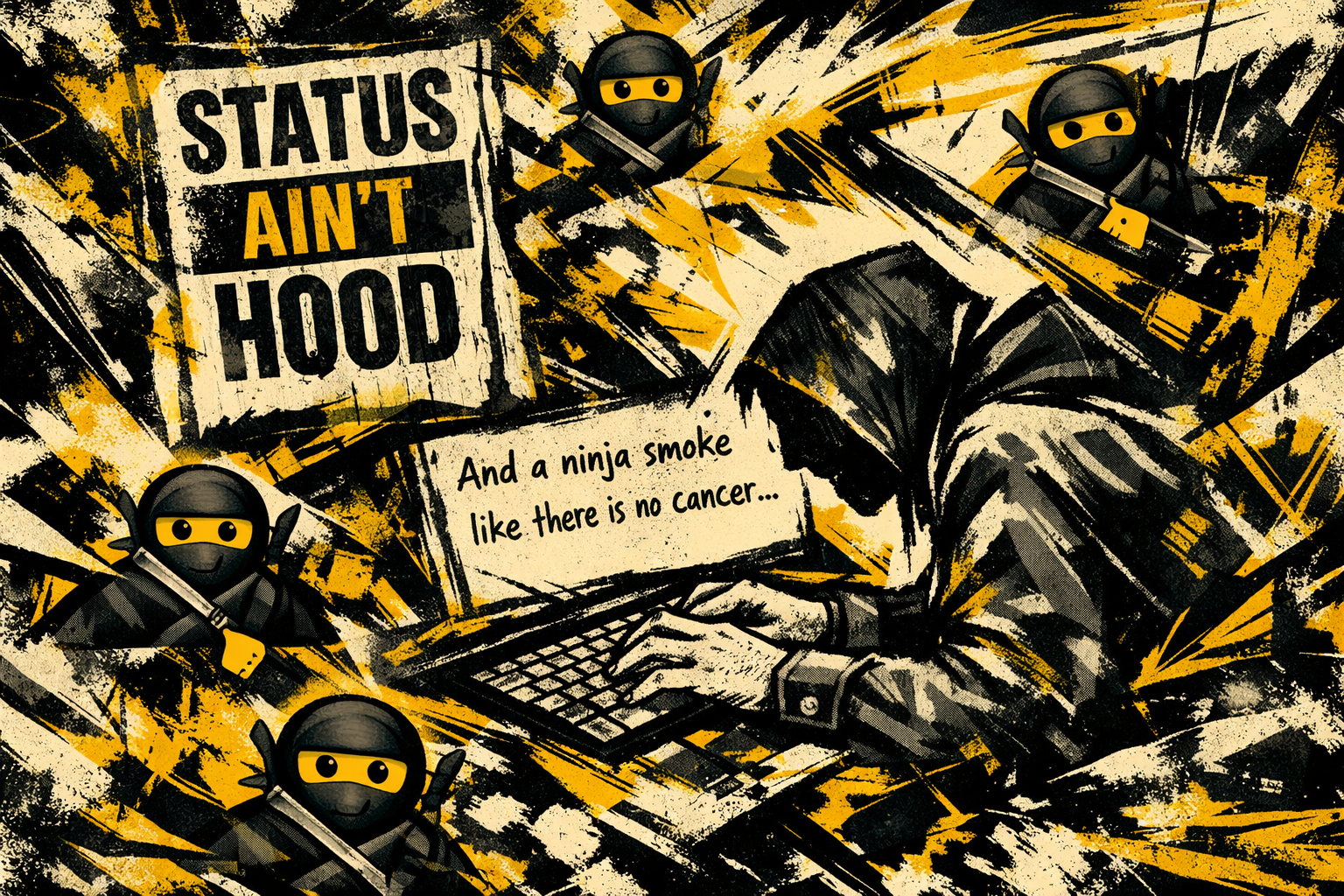
There's a specific moment in mid-2006 where you can locate the exact spot this all started. Tom Breihan was writing "Status Ain't Hood" for the Village Voice, one of the better hip-hop blogs running at the time, not in spite of the institutional masthead but largely independent of it, and he had developed a habit of quoting rap lyrics with the slur intact. He wasn't saying it, he was quoting it. There's a difference, arguably, if only because it removes the immediate physical danger of getting slugged in the mouth for saying it. The hip-hop writers who came up through print had navigated this question in various ways for years, usually through dashes or asterisks or the clinical construction "the N-word," all of which carry their own awkwardness.
In July 2006, Kris Ex, then blogging for XXL, called Breihan out specifically on this, characterizing him as someone "who would never say the N-word, but seem[s] to go out of [his] way to quote rap lyrics that use it." It was a pointed and fair observation, and Breihan, to his credit, didn't dismiss it. He reached out to Kris Ex directly, they talked, and he started doing something different.
He started writing "ninja."
As in: quoting a Lil Wayne mixtape lyric as "And a ninja drink like the late Fred Sanford / And a ninja smoke like there is no cancer." The substitution was phonetically adjacent, rhythmically functional, and funnier than asterisks, which was Breihan's stated reasoning. "I did that instead of using [asterisks or dashes] just because I thought this way was funnier, and it kind of defused the situation," he told Ben Westhoff of the Dallas Observer in a 2008 piece on the word's continued presence in hip-hop discourse. "It draws absurdity to the situation. I'm a white dude writing about rap and, obviously, on a certain cultural level, very much out of my depth."
That's a remarkably self-aware thing to say, and it's probably why the conversation around this has remained complicated rather than settled.
Breihan's career up to that point had been built on being genuinely good at writing about rap from an outside vantage point. The Village Voice had a long history of serious criticism, and "Status Ain't Hood" was well-regarded in the blog-era ecosystem. He went on to write for Pitchfork, GQ, Grantland, and others before eventually landing at Stereogum, where he's spent the better part of a decade writing "The Number Ones," a column working through every Billboard Hot 100 chart-topper in chronological order. That column became a book in 2023. He is, by any measure, a music writer with a real body of work and a demonstrated commitment to the craft.
Which makes the "ninja" thing worth taking seriously rather than dismissing in either direction.
What happened after Breihan started doing it is where it gets complicated. The substitution traveled. Other writers, predominantly but not exclusively white, picked it up as a practice, and what had been one critic's idiosyncratic solution to a specific editorial problem became something closer to a convention. By the time Ben Westhoff was writing about it in 2008, it had already moved beyond the "Status Ain't Hood" comments section into broader usage. Dallas Penn's site hosted a response at the time from Combat Jack, Reggie Osse, the attorney and podcaster who passed away in 2017, that summed up the structural problem clearly: "White rap critics are between a rock and a hard place here - they can either expose themselves to allegations of racism by keeping quotes and song lyrics intact, or they can resort to inevitably awkward substitutes like 'ninja.'"
A fair statement of the dilemma. But it doesn't settle whether "ninja" was a good solution or just a more comfortable one.
The case for it is straightforward enough. When you're quoting lyrics verbatim, you are not using the word, you are transcribing it, and there's a real editorial argument that reproducing quoted material accurately serves the reader and the work being discussed. Asterisks obscure meaning. "The N-word" in the middle of a lyric quote reads clinically, breaks the rhythm, and treats the reader like they might not know what word is being referenced, which is its own kind of condescension. "Ninja" at least acknowledges the specific word's presence in the lyric without requiring the white writer to type it in full, and the absurdity Breihan mentioned is real: you know what it means, he knows what it means, everybody knows what it means, and the comedy of the substitution is actually kind of candid about that shared knowledge.
Breihan himself was also clear about his scope. He specified on the Dallas Penn comment thread in real time that he used "ninja" only when quoting songs or interviews, never in his own voice. That's a meaningful distinction. He wasn't using it as slang. He was using it as a typographic stand-in for a quoted word, which is a different thing.
The case against it requires sitting with what actually happened when it spread.
The problem with a creative solution to a social problem is that the creative part tends to travel further than the social awareness that motivated it. Breihan came to "ninja" out of a genuine engagement with the criticism Kris Ex raised. He didn't dismiss it, he tried to respond to it, and he had the self-awareness to acknowledge the inherent strangeness of his position. That context mattered. But the writers who picked it up later didn't all carry that context with them. What they got was a phonetically similar substitute that lets you quote the word without typing the word, and it's kind of funny. That's a much more comfortable place to write from.
There's a version of this critique that says "ninja" didn't solve the problem of white writers quoting the slur. It just made white writers more comfortable doing it. The awkwardness of asterisks or dashes or "the N-word" was functionally useful precisely because it was awkward, because it forced a pause, because it made both the writer and the reader sit with what was actually being said. "Ninja" smoothed that over. It made the quote more readable, and in doing so, it probably made writers less likely to think carefully about whether they needed the quote at all.
There's also the question of what "adjacent" means in practice. "Ninja" is not the slur. But it shares enough sonic DNA with the slur that it operates, in context, as a near-equivalent, which is presumably the point, since it's used to substitute for it in quoted lyrics. If you're not allowed to say the word at a concert and you say "ninja" instead, you are not not-saying the word. You're saying it at one degree of removal. The logic that made the substitution seem clever is also the logic that made it a little too comfortable as a widespread practice.
This question doesn't have a clean answer, and a fair treatment of it probably has to acknowledge that. Breihan didn't invent a convention out of bad faith. He invented it out of a genuine attempt to respond to criticism from inside the culture, and the criticism came from a Black writer who engaged with him as a peer. The conversation that generated "ninja" was a more productive one than most of these conversations turn out to be. And the word's travel into broader use, into gaming culture, into meme formats, into casual substitution among non-Black fans singing along to songs, happened downstream of Breihan's specific editorial context, in places where nobody was thinking carefully about any of this.
The problem may have always been structural: that the convention of quoting rap lyrics verbatim in criticism was itself something worth interrogating, and that "ninja" was a band-aid on a question that needed more surgery. It's also possible it was a reasonable editorial compromise that got misapplied in places its inventor didn't intend. Both of those things can be true simultaneously.
Tom Breihan is, as of this writing, still at Stereogum, still working through the Hot 100 in chronological order, still producing work that gets read seriously by people who care about this stuff. The "ninja" period at the Village Voice was a specific moment in a long career, and like most specific moments it tells you something true about the time it came from, the blog era, the early engagement between rap criticism and racial identity in digital spaces, the question of who got to write about what and with what vocabulary. Those questions haven't gone away. They've just moved to different rooms.
The ninja got out of the room, though. That part's undeniable.🥷